
What's On : Awareness - October 2026
Updated: Oct 8
This section aims to highlight news, views & events relating to the surviving & thriving of life in North West Tasmania

Event by Bob Brown Foundation
Public · Anyone on or off Facebook
Join us for a free screening of Bob Brown Foundation's new short film, 'Gutted: the fight against Tasmania’s fish farms'.
The film covers some of the biggest actions, protests and controversies in the fight to protect Lutruwita / Tasmania’s waters from the toxic salmon industry.
Stay afterwards for a Q&A.

Event by Education for Sustainability Tasmania and Palawa kipli
Sustainability Learning Centre
Make Sustainability Teaching Easier in 2027
Find practical programs, classroom resources, free incursions and fresh ideas, without spending hours searching for them yourself.
Join teachers and sustainability educators from across Tasmania at the Education for Sustainability Tasmania Teachers' Fair on 18 October. Explore curriculum-linked resources, meet education providers, build your professional network, and go in the draw to win a $1,500 What Is Waste Teacher Toolkit.
From Kuno Earth: The only planet in the known Universe to support life, Earth has sustained humanity and a sublime natural world for millennia. Kuno is your platform..

Tiger Plain is located within the Coast to Cradle Wild Country on the northeastern edge of the Black Bluff Nature Recreation Area. Tiger Plain is an evocative place connected to past encounters with the Tasmanian Tiger (Thylacinus cynosephalus).
In the 1860’s the mineral prospector James ‘Philosopher’ Smith regarded Tiger Plain as the most “tiger-infested” place he'd visited in Tasmania, and is where he once killed a female and found four pouch young. The last confirmed Thylacine died on 7 September 1936 in Hobart’s Beaumaris Zoo due, in large part, to neglect. Two months later the species was granted formal protection, but no replacement zoo exhibit was found.
Upcoming Sustainability & Environmental Events in North West / Northern Tasmania
Dispatches from the Far South: A free public talk by physical oceanographer Dr. Edward Doddridge on changing Antarctic ocean systems and global impacts, hosted as part of the Island of Ideas series.
Date: Thursday, 15 October 2026 at 18:00
Location: University of Tasmania, Cradle Coast Campus, Burnie
Burnie Seed Library Session: A community chat and learning session focused on gardening, seed-saving, and growing edible plants from seeds.
Date: Tuesday, 3 November 2026 at 16:30
Location: Burnie Library, Alexander Street, Burnie
Tasmanian Community Landcare Gathering: A three-day regional event bringing together landholders, farmers, and volunteers for environmental action, field trips, and knowledge-sharing workshops.
Date: Friday, 6 November 2026 at 15:00
Location: Deloraine Community Complex, Deloraine
Here is a snapshot of issues currently facing North West community
North West Tasmania faces several major sustainability challenges spanning renewable energy expansion, agricultural pressures, and marine and land ecosystem health.
Key Sustainability Issues
Renewable Energy & Transmission
Large-scale clean energy projects—such as the Robins Island wind farm development and the North West Transmission Developments—aim to support the national transition to low-carbon energy. However, these projects face strong local social licence challenges regarding visual amenity, sacred First Nations land, and potential impacts on endangered species like the orange-bellied parrot.
Ecosystem & Biodiversity Pressures
The Tasmanian State of the Environment Report highlights severe pressures on regional biodiversity, including threats to native plants and escalating risks of extinction. Warming coastal waters and invasive pests further destabilise local marine and terrestrial habitats.
Water & Agricultural Management
Intensive regional farming and rural industries face growing constraints from variable rainfall patterns, prolonged dry spells, and water scarcity. Balancing agricultural productivity with catchment health and environmental water flows remains an ongoing challenge
Aquaculture & Water Quality
Regional freshwater resources and coastal ecosystems experience stress from industrial activities and flow-through aquaculture operations, which add excess nutrients and nitrogen into local waterways. Transitioning toward recirculating systems is a key focus for local environmental groups.

North West Transmission Developments (NWTD): The $1.3 billion transmission line project faces ongoing legal challenges and community pushback regarding environmental impacts as it prepares to feed local power into the subsea Marinus Link.
Robbins Island Wind Farm: The 100-turbine project in the far north-west has received environmental approval but faces local opposition over potential disruptions to wildlife, including disease risks to disease-free Tasmanian devil populations.
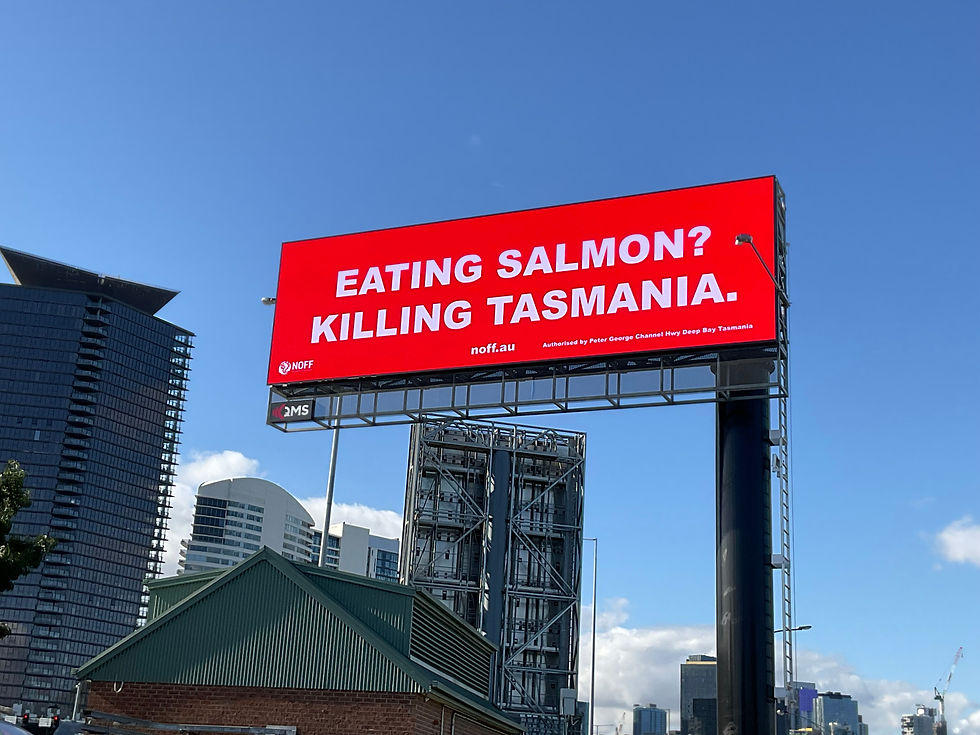
Founded in 2015, NOFF is a not-for-profit organisation driven by volunteers. Our organising team and members represent a wide range of backgrounds all united by a deep belief that our communities and natural environments should not be exploited or harmed.
Our Goal
Our goal is to save Tasmanian's unique natural waterways from the damage being caused by the multinational Atlantic salmon industry.
This is achieved by removing salmon feedlots and hatcheries from vulnerable, shallow coastal waters and rivers, and made possible by influencing the practices of industry and regulators, and the decisions of government, consumers and the general public.


Comments