
Live Well Tasmania: Towards Inner Transition, Sustainability and the Good Life: Part 1.
In the first of this series, I will introduce Live Well Tasmania, and discuss how personal sustainability and inner transition/growth can be seen as our greatest lever of change towards human surviving and thriving, that is, towards economic, social and environmental sustainability. At the same time, inner transition/growth can also be seen as the key to the good life.
In turn, Transition Towns can support personal sustainability and inner transition/growth. In the second part, I will discuss Community Based Income as a means of promoting Transition Towns to help build the good life for everyone. In part three, I will discuss why it is so hard for us to adopt sustainable behaviours, including the idea that our current culture is one of ‘permanent adolescence’, hence ‘growing up’ is part of our current challenge.
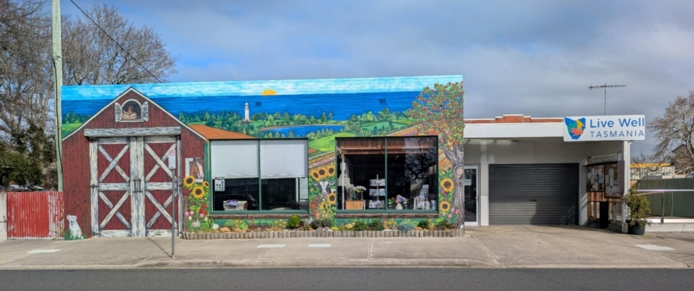
Live Well Tasmania’s (LWT) is a small non-profit community group with a Community Centre in Wynyard and a Community Farm in Oldina. We became incorporated in 2015, and our mission is to improve health and wellbeing, community capacity and community resilience and build sustainable communities. We adopted the name of Live Well due to the urgent and profound necessity of letting go of economic growth as in effect the key driver of all government (and most non-government) policy, and which also in effect more or less rules our lives. Despite the impossibility of infinite economic growth on a finite planet, economic growth is seen as providing security, denying that our own personal sense of security, that is, inner security, is ultimately what is most important.
Live Well Tasmania instead promotes a ‘wellbeing economy’ approach, where social relationships are a key pillar of wellbeing. Joy is another key concept, re-discovering the joy in simple pleasures of connecting with others, of finding meaning and purpose in serving other people and the environment. We very much subscribe to the permaculture ethics of Care of People, Care of Planet and Fair Share. David Holmglen, the co-founder of permaculture, also includes in the ethic of Fair Share that of limiting consumption, along the lines of ‘Live Simply, so that others may Simply Live”.
In this view, social sustainability involves promoting human well-being, equality, democratic government, and democratic civil society, based on a social system where trust, meaningfulness, diversity, learning capacity, and the possibility of self-organisation are essential. A basic requirement for social sustainability is ‘sustainability agency’, also called personal sustainability, being the capacity to act toward sustainable futures. The qualities of self-guidance, self-knowledge and self-care as the foundation of the good life, also promote personal sustainability. In addition understanding those who are different, and having good conflict resolution skills are also vital for the Good Life and promoting sustainability.

Overlapping with personal sustainability, we are all being called to be better people, and thereby somewhat paradoxically to live the Good Life. The latter not in a hedonistic way, seeking maximum pleasure while taking minimal responsibility, rather the goal is to engage in activities that enhance our lives, the lives of other people and enhance the environment, thereby creating a purposeful life. Personal benefits involved in embracing sustainability arise because wholehearted engagement with positive agendas like sustainability offers an increased sense of meaning and purpose in life and increases our awareness of our inner drivers. Therefore sustainability is more about personal development than about sacrifice.
Being a hyper social species, relational health is vital, that is, the quality of our relationships with each other. In particular we gain increased energy and motivation by working with others including by sharing the load. Another source of purpose is focussing on the future, creating security for all. We can gain a lot of satisfaction from satisfying basic needs, and doing it with others at the same time improving our own psychological resources is the trifecta of sustainable actions.
The Transition Town movement epitomises this well.
Transition Towns are grassroots community initiatives focused on building local resilience, sustainability, and self-sufficiency to tackle climate change, peak oil, and economic instability. By fostering re-localisation, renewable energy, food security, and stronger social ties, these groups aim to create low-carbon, thriving futures. Inner Transition in Transition Towns focuses on the psychological, emotional, and spiritual shifts needed to create a sustainable, resilient, and caring culture. It complements practical actions by fostering self-awareness, connection with nature, emotional resilience, and healthy group dynamics, ensuring personal growth supports wider community change.
While there is only one official Transition Town group in Tasmania, Transition Tamar (see https://www.facebook.com/TransitionTamar), LWT has a number of initiatives promoting ‘Inner Transition’ or inner growth. Firstly we have a two hour weekly meeting of Grow, whereby Grow is an Australia wide unique program of mutual support and personal development. Secondly we also recently ran a successful trial of Care Farming at our Community Farm, and the participants have continued coming weekly to the farm to keep benefiting from the social and nature interaction.

Volunteers at the Live Well Community
So how can you embark on this path towards having a better life, towards the Good Life, and adopting sustainability behaviours? One way is to research ways to become more resilient, to better interact with others, etc. For example I asked AI about this, and the first part of the reply I got was “Becoming a better person and especially more resilient is absolutely achievable—and it doesn’t require a personality transplant. It comes from small, repeatable shifts in how you think, regulate emotion, connect with others, and build meaning”. It then gave nine subheadings of area’s of growth, based on what psychology, neuroscience, and positive development research consistently show works. Our Tasmanian library also has great books on self-development, but the key of course is practice, practice, practice!


Comments